


Fixed gas detectors play a critical role in protecting personnel, assets, and operations from hazardous gas exposure.
As facilities grow, however, so do the challenges associated with maintaining gas detection systems. A wastewater treatment facility may have detectors installed across pump stations, wet wells, treatment buildings, and confined spaces. A manufacturing site could have gas monitoring points distributed throughout production areas, utility systems, storage facilities, and process equipment.
As the number of detectors increases, maintenance teams face a familiar challenge: when a detector reports a fault, how quickly can they determine whether the issue is related to the sensor, calibration status, configuration settings, or the detector itself?
Gas readings alone do not always explain why a detector requires attention. As fixed gas detection systems expand, maintenance teams need faster ways to identify potential issues, prioritise service activities, and minimise unnecessary site visits.
This is one reason communication technologies are becoming increasingly important in modern gas detection systems.
The Role of HART Communication
HART (Highway Addressable Remote Transducer) is a communication protocol widely used throughout industrial instrumentation.
In addition to transmitting measurement values through a standard 4–20 mA signal, HART provides access to information such as diagnostics, configuration parameters, device status information, and other operating data.
By providing access to information beyond the standard measurement signal, HART communication can offer additional visibility into detector status and operation.
Introducing the WatchGas TOX Point 2000
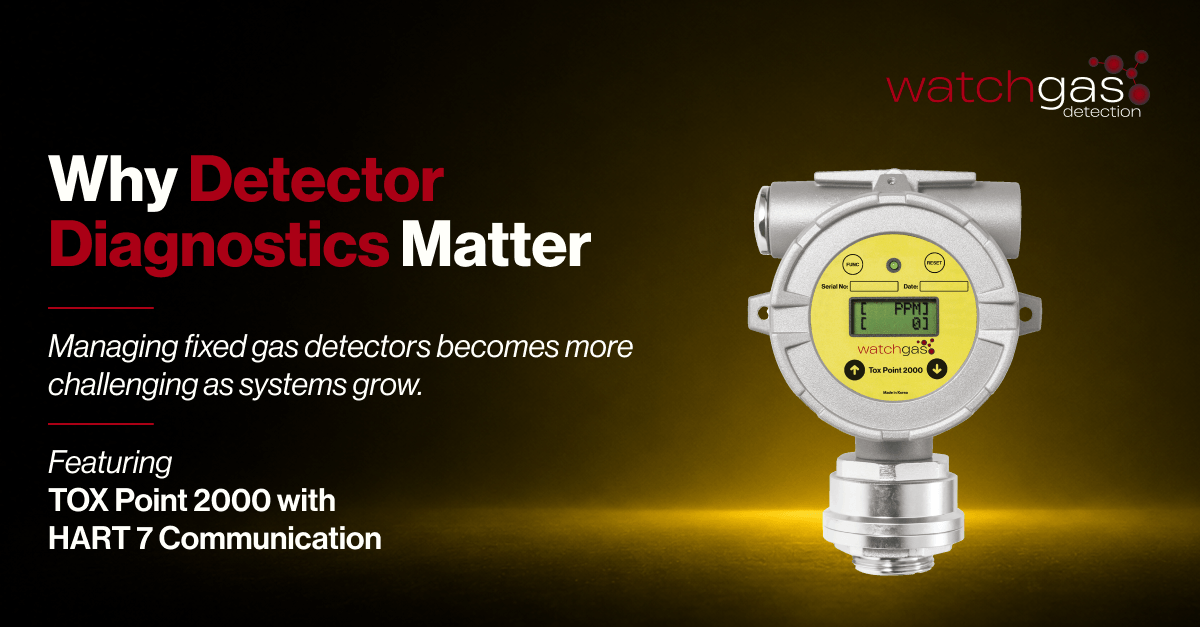
The WatchGas TOX Point 2000 is a smart diffusion gas detector designed for monitoring toxic gases, oxygen in hazardous industrial environments. It combines HART 7 communication, an integrated display, and non-intrusive testing capabilities, one man calibration. In a platform designed for industrial gas detection applications.
Designed for Easier Detector Management
For facilities managing multiple gas detectors across a site, access to this additional information can support more efficient maintenance activities and improved visibility of detector status. With the capabilities of a HART output, the Tox Point 2000 can contribute to enhancing this process efficiency.
Simplified Calibration and Maintenance
The TOX Point 2000 features non-intrusive magnetic operation, allowing technicians to perform calibration, configuration, and maintenance activities using a magnetic bar rather than conventional intrusive testing techniques. This approach supports one-person calibration and servicing directly at the detector whilst making routine maintenance activities in hazardous environments more efficient.
One Platform for Multiple Gas Monitoring Requirements
A wastewater treatment facility may require hydrogen sulfide, ammonia, and chlorine monitoring, while manufacturing and chemical processing sites often need to monitor a different combination of toxic gases, oxygen levels. The TOX Point 2000 is designed to support these varying requirements within a single detector platform, helping organisations maintain consistency across different process areas while addressing site-specific monitoring needs.
Built for Industrial Environments Worldwide
The TOX Point 2000 is available with aluminium or stainless-steel housing options and features explosion-proof construction for hazardous locations. It carries a broad range of approvals, including ATEX, IECEx, UL, FM certifications, supporting deployment across a wide range of industrial applications.
Available LCD and OLED display options provide visibility of operating status and gas readings, while multiple housing options allow the detector to be matched to different installation requirements and operating environments.
Explore the WatchGas TOX Point 2000 to learn more about available sensor technologies, communication capabilities, certifications, and application suitability.