






Could your facility detect a toxic gas hazard before it puts workers at risk?
It’s 6:30 AM at a wastewater treatment facility.
A maintenance technician is preparing to inspect a pump station before the day’s operations begin. While the task itself is routine, wastewater processes can generate hydrogen sulfide (H₂S), a toxic gas that may accumulate around wet wells, treatment equipment, and other confined or poorly ventilated areas.
The challenge is that gas conditions can change between inspections, making it difficult to rely solely on periodic checks to identify potential hazards.
Why continuous toxic gas monitoring matters
Industrial facilities face different gas hazards depending on their operations, from hydrogen sulfide (H₂S) and ammonia (NH₃) in wastewater treatment and chlorine (Cl₂) in water treatment to ammonia (NH₃) in refrigeration systems and carbon monoxide (CO) in manufacturing environments.
In these applications, gas conditions can change rapidly and may not be identified through routine inspections alone. Fixed gas detection provides continuous monitoring of higher-risk areas, helping safety teams maintain awareness of atmospheric conditions and respond more effectively when conditions change.
Choosing the right fixed toxic gas detector
When evaluating a fixed gas detection solution, it is easy to focus on advanced communication capabilities, complex system architectures, or extensive feature lists. For many facilities, however, the priorities are more practical. Safety teams need equipment that can be deployed across multiple monitoring points, integrated into existing systems, and maintained efficiently throughout its operating life. The right detector is often the one that delivers dependable performance while remaining straightforward to manage on a day-to-day basis.
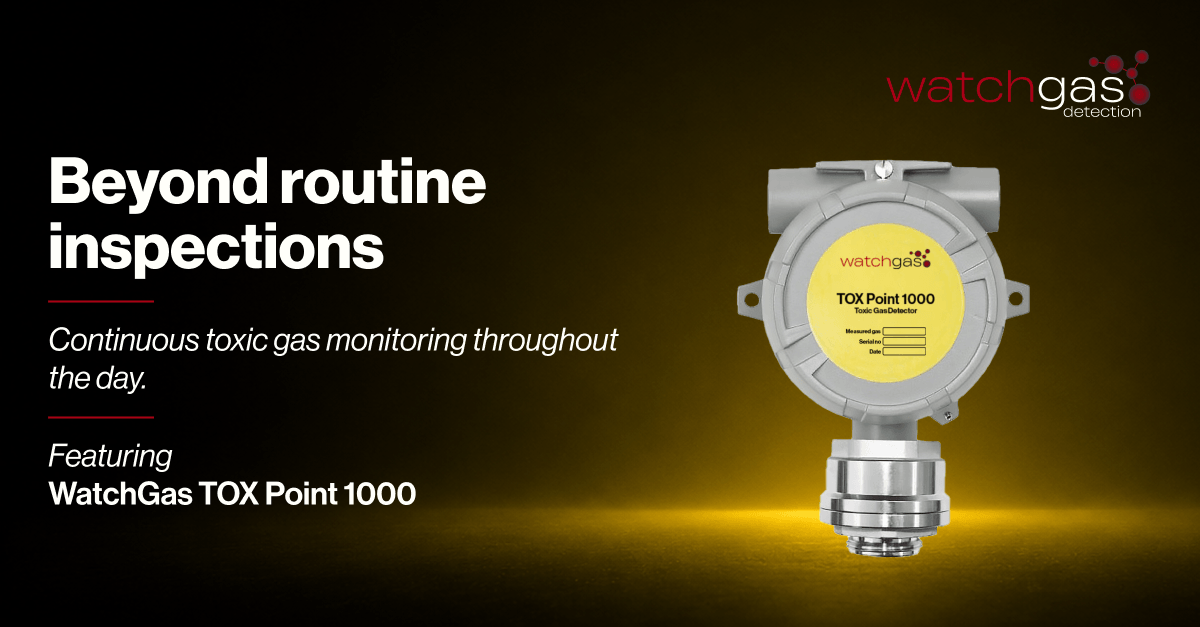
Introducing the WatchGas TOX Point 1000
The WatchGas TOX Point 1000 is a fixed gas detector designed for toxic gas and oxygen monitoring in industrial environments. It combines broad gas coverage, flexible system integration, and efficient maintenance in a single detector platform.
Key features of TOX Point 1000
Multi-gas and oxygen monitoring
Support for a wide range of toxic gases and oxygen monitoring applications, allowing facilities to standardize monitoring across multiple areas using a single detector platform.
One-person maintenance capability
Helping technicians complete calibration and service tasks more quickly while reducing maintenance effort and downtime.
Flexible 2-wire and 3-wire configurations
Simplifying integration into both new and existing fixed gas detection systems.
Flexible system integration
With support for connection to site SCADA systems or WatchGas GTC-100 standalone controllers for centralized monitoring and alarm management.
Explosion-proof construction
With ATEX and IECEx certifications for installation in hazardous locations.
Corrosion-resistant construction
Combining an aluminium alloy housing with an SS316 sensor assembly for long-term durability in demanding operating environments.
Together, these capabilities help simplify deployment, maintenance, and long-term management of fixed gas detection systems.
Applications of TOX Point 1000
TOX Point 1000 is suitable for a broad range of industrial applications, including:
Wastewater treatment facilities
Monitor hydrogen sulfide (H₂S), ammonia (NH₃), and other toxic gases around wet wells, pump stations, treatment processes, and confined spaces where toxic gas accumulation may occur.
Water treatment and utilities
Detect chlorine and other treatment-related gases to help protect personnel and maintain safe operating conditions.
Manufacturing facilities
Monitor toxic gases generated by production processes, combustion equipment, or chemical handling operations.
Food and beverage processing
Support ammonia (NH₃) monitoring in refrigeration systems and other critical process areas.
Power generation sites
Provide continuous monitoring of oxygen levels and toxic gases associated with plant operations and maintenance activities.
General industrial facilities
Help identify gas hazards in storage areas, process equipment, utility infrastructure, and other higher-risk locations.
Ready to evaluate whether TOX Point 1000 is the right fit for your application?
Explore TOX Point 1000 to learn more about available sensor options, certifications, technical specifications, and application details.
Interested in TOX Point 1000?
Have questions about TOX Point 1000 or want to discuss your gas detection requirements? Contact our gas detection specialists to discuss your application.