






CO and HCN: Understanding the “Toxic Twins” in Fire Overhaul
The flames are out. The smoke is lighter. The scene looks more controlled.
But during overhaul, the air can still contain invisible toxic gases, especially carbon monoxide (CO) and hydrogen cyanide (HCN), often referred to in the fire industry as the “toxic twins.” Both can be present in fire smoke, and both affect the body’s ability to transport or use oxygen.
CO is colorless and odorless, making it difficult to recognize without monitoring. It can remain a risk during overhaul and post-incident work, even after visible fire conditions have improved.
In one NIOSH (*) firefighter fatality investigation from Massachusetts, a firefighter collapsed while performing overhaul after a residential structure fire. The Medical Examiner’s report listed carbon monoxide toxicity as the immediate cause of death, highlighting why the overhaul atmosphere should still be treated seriously.
HCN is another high-consequence toxic gas associated with fire smoke, particularly where synthetic materials, plastics, foams, insulation, or treated products are involved. NIOSH lists 50 ppm as IDLH (Immediately Dangerous to Life or Health) for hydrogen cyanide, underlining how serious HCN exposure can be.
CO and HCN are often discussed together because they create different but related oxygen-use risks: CO reduces oxygen transport in the blood, while HCN interferes with oxygen use at the cellular level.
On scene, a firefighter may feel dizzy, weak, confused, or short of breath, but those signs can be difficult to separate from fatigue, heat stress, or exertion. In a fireground environment, symptoms do not always tell the full story.
That is where atmospheric monitoring becomes critical. It helps fire-service teams look beyond the obvious question: “Is CO present?”, and consider another important risk: “Could HCN also be part of the exposure?”
Where the WatchGas SST5 fits
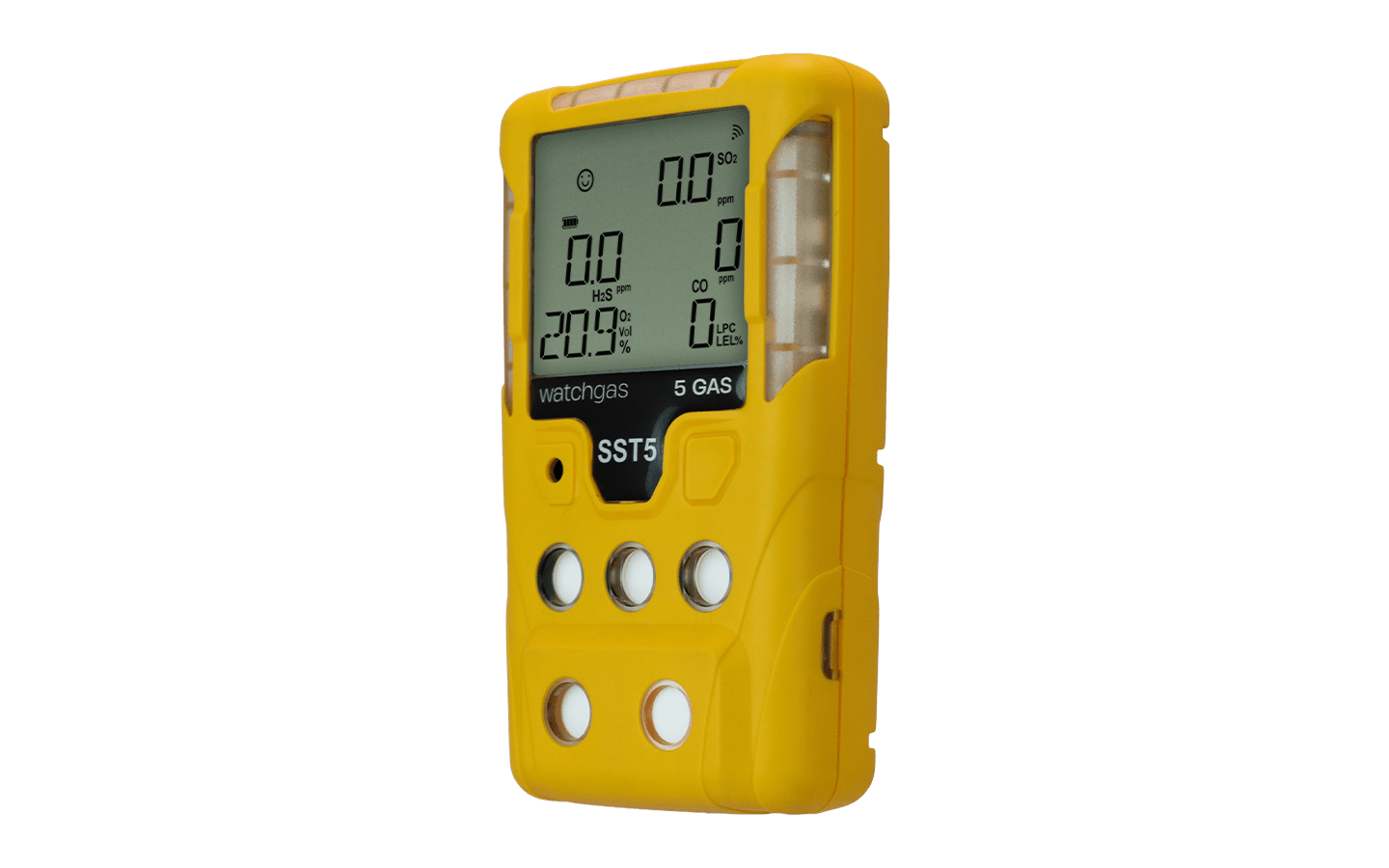
The WatchGas SST5 helps fire-service teams monitor CO and HCN in one compact wearable five-gas detector.
For HCN, SST5 offers both filtered and unfiltered sensor options, so teams can choose the configuration that fits their application and risk profile.
SST5 is built for demanding field use: it is compact enough to wear in the breathing zone, typically around 40% smaller and 25% lighter than comparable five-gas diffusion portable detectors, and features a 95 dB alarm at 30 cm, a large multi-gas display, NFC communication, induction charging, event/data logging, and an IP65/68 rugged design.
Beyond CO and HCN, SST5 can also be configured for O₂, LEL, H₂S, SO₂, NH₃, Cl₂, ETO, NO, and NO₂ gases, as well as an Xs broad-band sensor for certain organic gases and vapors.
When sight is not enough, monitoring matters. Explore SST5 for compact CO and HCN detection in fire-service applications: Discover SST5
(*) NIOSH: National Institute for Occupational Safety and Health
-
1 to 5-Gas Detection
-
Compact & Lightweight
SST5 5-gas
Meet the new WatchGas SST5 - the next generation of compact multi-gas detection. Designed for maximum comfort and reliable protection, the SST5 delivers powerful 1 to 5-gas monitoring in an ultra-lightweight design with fast sensor response, long runtime, and industry-leading visibility and alarm performance.